Find Your Labor Flow
When you’re expecting a baby, you will hear a lot about needing a birth plan in place, and sometimes even a postpartum plan - both are a good idea. But have you heard that you should have a labor plan, too?
If you are planning an unmedicated labor, having a labor plan is a must. It is so important to have ideas of how to cope laid out beforehand, and not get stuck in the moment with intense contractions and having no idea of what will help you next. This is also where a Doula comes in handy!
I like to think of labor plans as a flowing river, simply moving from one thing to the next as needed. It can be helpful to brainstorm some ideas that you usually use to help you relax in every day life. Do you like to relax in a warm bath, listen to calming music, diffuse some essential oils for aromatherapy? Any of those things are a good starting point for coping ideas during labor.
Once you gather the ideas that you know work for you, it is a good idea to add even more things that you can rotate through to help find relief. Some other coping strategies for labor pains are:
using a birth ball or peanut ball
massage/massage tools
hip squeezes/sacral pressure/counter pressure
walking
changing positions
swaying
warm or cold compresses
labor comb
breathing
affirmations
guided meditation
vocalizations
Some parts of your labor plan will also be part of your birth plan - having a quiet dim room, minimizing distractions and visitors, being able to move around and eat/drink as you would like. It is so important to be in a setting that is comfortable and relaxing for you - if you don’t feel safe, your body can stop your labor/progress altogether.
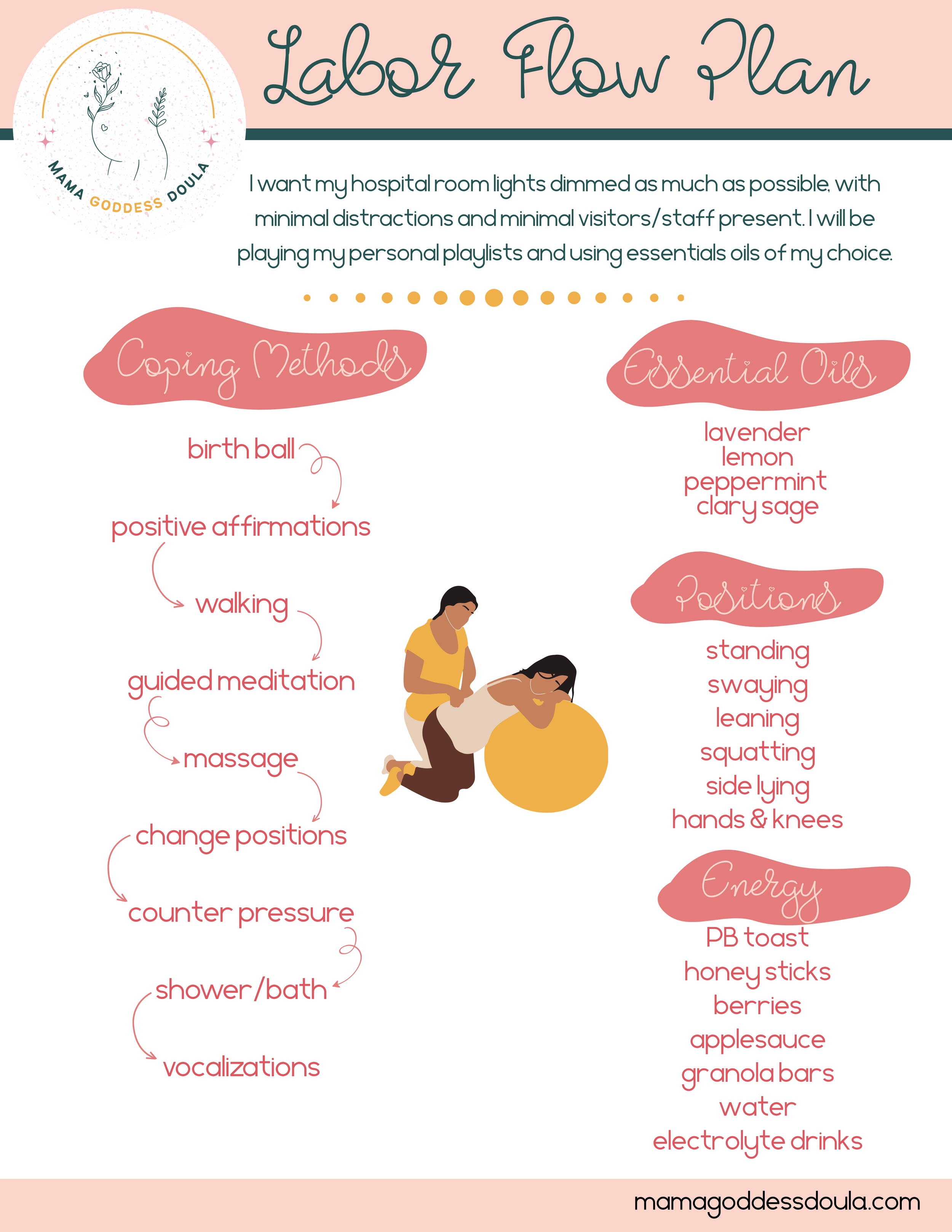
Once you have established the room setting you would like to have in your birth plan, you can put together your flow of coping ideas. Flexibility in labor/childbirth is a must, so remember you do not need to completely adhere to this flow, but to use it as a guideline if you find yourself stuck. Some things will work better in early labor versus active labor. An important thing to consider when laying out the flow is not putting two things together that are too similar. If you are having trouble coping while doing guided meditation, switching to repeating affirmations probably isn’t going to be enough change to help much. In addition to that, you can always combine coping methods - repeating affirmations while using the birth ball, squeezing the labor comb while you’re in the bath or shower.
Another good reminder is when you find something that works, ride it out until it doesn't anymore. As long as you and baby are coping well, stay doing what you are doing as long as it feels good to you. At a certain point it may feel like nothing you're doing is helping, and it is okay to move around as you need to, be vocal, and speak up for what you want/need or don't want - this is your body, your baby, and your birth.
Something else important to consider adding to your labor plan is what to do if you suddenly decide you want to use medicated pain managment or want to get an epidural. While it can be helpful for your support person(s) to remind you that it isn't what you want, you may be in no mood to listen. At that point, it may be helpful to try the rule of 3 - try three different positions, and get through three contractions and three rest periods with each one. Once you have made it through close to ten more contractions, you will be that much closer to meeting your baby, and perhaps gained some new strength to keep going with your original plan.
See below for a sample labor flow plan!